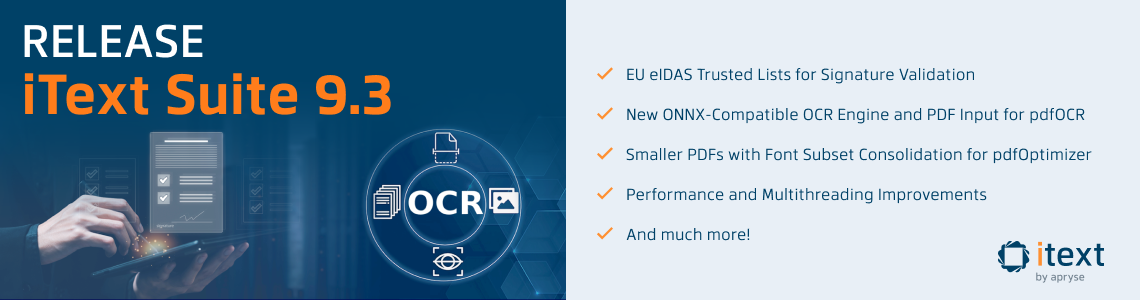
As we enter the third quarter of 2025, here is the latest release of the iText Suite: version 9.3. Included in this release is iText Core 9.3.0, which brings support for the EU trusted lists for signature validation, along with improvements to thread safeness and further work on the .NET MAUI support we introduced in version 9.2.0.
Elsewhere in the iText Suite, we have important updates to the pdfOCR and pdfOptimizer add-ons. For pdfOCR we've introduced support for Machine Learning-based OCR engines which follow the Open Neural Network Exchange (ONNX) model. This hugely extends pdfOCR's capabilities beyond the existing Tesseract 4.x implementation, particularly when it comes to recognition of English and other Latin-based languages.
For pdfOptimizer, the optimization of embedded fonts sees a major upgrade. This can result in significantly smaller file sizes with no loss in document quality.
See below for more information, and you can find full details on the new features and changes in the linked release notes on our Knowledge Base.
Release iText Core 9.3.0
EU Trusted Lists in Validation
For this release of Apryse's leading open-source PDF library, our primary focus continues to be simplifying digital signing and signature validation. We've made a huge step towards our goal with the introduction of support for the retrieval, validation, and usage of the EU’s List of Trusted Lists (LOTL).
What is the LOTL?
Believe it or not, LOTL is not a typo of LOTR. It stands for the List of Trusted Lists (not Lord of The Lists as some of you might be thinking).
The LOTL is an official resource identifying the organizations which are authorized by European governments to provide safe and reliable digital identity and electronic signature services. It consists of an XML file of country-specific trusted lists, which in turn contain various certificates considered to be trustworthy for use during PDF signature validation.
By utilizing these lists iText can confirm whether digital signatures or electronic seals are legitimately trustworthy, and legally valid for the relevant country or region under EU laws. You can be sure that signatures validated with iText will meet the stringent European standards for trust and authenticity defined by the eIDAS regulations.
We've created a dedicated repository on our GitHub which acts as an optional dependency for iText Core. See the Knowledge Base article for full details on the implementation and usage of the LOTL cache.
Thread Safety Improvements
Internal updates have improved thread safety across key components, making iText Core more robust in multithreaded environments. This is especially beneficial for developers building scalable, concurrent applications.
pdfCalligraph 5.0.3
The pdfCalligraph add-on provides advanced typography support when creating PDF documents, enabling you to expand your document workflow with accurate rendering for global languages and writing systems.
This release is mainly to maintain compatibility with the iText Core 9.3.0 dependencies.
Release pdfHTML 6.2.1
While nominally a patch release of our add-on for generating PDF from HTML/XML and CSS templates, it does bring fixes for layout calculations and tagging. There are also improvements in the handling of anchor tags with object references for better accessibility and structure.
Release pdfOCR 4.1.0
pdfOCR is our add-on for iText Core to perform OCR on documents and images. For this release, the big news is we're introducing the new pdfocr-onnxtr module, providing a high-performance machine learning-based OCR implementation as an alternative to the traditional Tesseract 4 engine.
New ONNX-Based Recognition Engine
The new OCR engine is powered by ONNX models, but what is ONNX? Well, it stands for the Open Neural Network Exchange and is an open format for machine learning models. It defines a common set of operators and also a common file format to enable AI developers to use models with various frameworks, tools, runtimes, and compilers.
A big advantage of ONNX is anyone can get access to high-quality OCR without having to spend a ton of time and money on AI hardware and finding datasets to train their own models. Why not let Microsoft or Google do the hard work for you?
What it means for iText though is a big upgrade in OCR capabilities. ML-based models deliver faster and more accurate recognition than traditional OCR engines, and by supporting the ONNX standard means we can leverage the growing number of pre-trained models in the community.
For this initial release we’ve ported the OnnxTR Python library, which is an ONNX implementation of the popular, high-performance docTR library. It comes with ONNX versions of pre-trained docTR models for fast and efficient text detection and recognition.
Our internal testing indicates excellent performance and accuracy for documents containing Latin-based text; the most common OCR use case. Official support for more engines, along with specialized detection and recognition models will be coming in future releases, However, you can already experiment with compatible models yourself. Learn more about our implementation and usage in the dedicated article on the Knowledge Base.
Note that pdfOCR’s OnnxTR module is not a replacement for the existing Tesseract 4 module. We originally designed pdfOCR to easily allow alternative OCR engines to be used, and this is no exception. Tesseract is a well-established OCR engine with excellent support for global languages, and so it’s easy to switch between engines if you run into issues with certain documents.
PDF as Input Support
pdfOCR now supports PDF documents as input, in addition to image files. This allows direct text recognition in scanned PDFs, without requiring external conversion.
SkiaSharp Integration on .NET
To support ONNX-based OCR workflows, we have replaced the System.Drawing.Common library for image processing on .NET. This was for a number of reasons, not least because it is deprecated in .NET 6+ and unsupported on non-Windows platforms. SkiaSharp offers much better cross-platform support, modern format compatibility (AVIF, HEIF, DNG), and more efficient JPEG compression.
For legacy workflows, System.Drawing remains available for Tesseract-based OCR workflows.
Release pdfOptimizer 4.1.0
The pdfOptimizer add-on provides variable ways to optimize PDFs, whether you’re generating them with iText or rewriting them after processing.
Font Subset Consolidation
New for pdfOptimizer is it now supports consolidation of duplicate font subsets for horizontal fonts. Merging is performed when intersected character IDs (CIDs) are identical across subsets. A new font object is created, and unused fonts are removed post-merge, reducing file size while preserving visual fidelity. You can learn more in the Knowledge Base article.
Release pdfSweep 5.0.3
The pdfSweep add-on is another open-source add-on for iText Core, which enables you to securely redact content from PDFs. This is essential when you need to completely remove confidential or sensitive information from documents.
This release is mainly to maintain compatibility with the iText Core 9.3.0 dependencies.
Release pdfXFA 5.0.3
pdfXFA is an iText Core add-on that allows you to flatten dynamic XFA forms to static PDF. It also enables you to add a digital signature to converted XFA forms as additional security for further processing in PDF workflows or for archiving.
There are no feature changes for this release. The only changes are to maintain compatibility with the iText Core 9.3.0 dependencies.
Pull Requests
We’d like to thank SangeethaDivya for their contribution to remove duplicate constants on .NET, which we used as a basis for a Java re-implementation and then ported it to .NET.
Thanks also to craffael who fixed a typo in the PDF/A-1 checking code which led to documents with no device-dependent color spaces failing the checks.
As always, head over to our GitHub if you’d like to contribute to iText’s continuing development.
Bug Fixes and Miscellaneous Improvements
A bug in PDF 2.0 structure destinations has been fixed, improving how tagged content is linked and navigated when converting from HTML. This is now more in line with the PDF 2.0 and PDF/UA-2 specifications and is particularly useful for accessibility and structured document workflows.
We’ve also fixed an issue related to color depth support in PDF image data streams, which would result in an com.itextpdf.io.exceptions.IOException: The color depth 1 is not supported. error.
We’ve also resolved a StackOverflowException resulting from invalid PDFs with cyclic references in the trailer dictionary, improving robustness and error handling.
For more details on other improvements and bug fixes, see the release notes for Core and the add-ons on the Knowledge Base.
Don't forget, the release notes contain links to our Java and .NET GitHub repositories which are continually updated with useful code samples for iText Core and its add-ons.
Showcase PDF
As in previous releases, we’ve made the Core release notes into a showcase PDF document. Not only does it conform to the latest PDF/UA-2 standard for accessible PDF documents, as well as the PDF/A-4F archiving standard, it’s also digitally signed.
It also handily demonstrates the high-level HTML-to-PDF/UA API we introduced in the previous release, which makes creating accessible PDF documents with iText easier than ever before.
You can find the source code and resources required to recreate the document yourself embedded. See the file attached to the release notes for more information.
Get Started with iText Suite 9.3
If you’re completely new to iText, we highly recommend our free 30-day trial. This lets you try out the entire iText Suite: so not just iText Core, but also all our open and closed source add-ons, completely free.
And because the trial is covered by the terms of our commercial license, you can be assured your intellectual property is safe. The AGPLv3 conditions do not apply to commercial license holders, so your code can remain closed-source if that is a concern for you.
As ever, happy coding!